Place Based Learning

Place based and/or culturally responsive learning:  In my literature classes, so far the only place based learning is in AK Lit.  That course is divided up following an Anthology of AK Lit into seven categories.  Right now we are starting at the beginning:  deep-time indigenous narratives.

I told a story I had read (Inupiaq I think) about ground squirrels turning into brown bears and vice versa. Then I related a story by a white author who wrote about mistaking ground squirrels for brown bears at a distance. I told this to some young guys who would rather be in shop class.  They laughed, but then I told them how the tundra is a lot like the ocean (something these guys know well) in that it often doesn’t lend itself to much perspective because there is often nothing against which to judge distance or size.

And then I told them my story about waking up in a foggy, pre-dawn in a tent while caribou hunting. I was with three friends when I woke to the sound of splashing in the creek we had hiked to the night before.  I peeked out the tent and peered through a sea of fog toward the sound.  There, standing on the edge of what must have been an island in the creek, was a bear.  The bear’s feet disappeared into the fog that hid the island but the rest of it’s brown fur glowed wet and shining in the grey gloom.  I gingerly woke up my friends in the tent and hissed at them to be quiet: there was a grizzly about 70 or 80 yards away. A big one.  A boar no doubt. I described this bear and what it was doing for many minutes until suddenly the sun came up, the fog parted a bit and I realized that I was looking not a large grizzly on an island in the creek, but at a fat little beaver at about the same distance on the other side of the creek.

Outside of that Sitka High has an outboard repair class (that to my own personal woe is not being taught this year).  An entire room is filled with outboards to be worked on.  Pretty relevant in this sea town for sure.

There is another LA/History teacher who teaches a History of Sitka course. He recently had the kids log onto Google Earth and locate various historical and/or prominent geographical locations around Sitka Sound. Then he gave the kids a Tlingit language key for all of the place names in Southeast that were cross reference with White names (some places had no White names I believe) and then label them with both names. Every Tlingit name had a translation I believe, which was pretty cool.
Place-based instruction at East High

For the amount of diversity I am surprised at the lack of diversity regarding the teaching methods at East High. Moreover, there is quite a lack of student-based learning. It is very teacher centric which leads me to believe the teachers think student learning either doesn’t work, is too much work for the teacher or teachers just don’t know the value of it. My host teacher, while he does the most that I have seen, says he has so much stuff to teach them sometimes he doesn’t have the time…

One of the things he does that is place-based is he takes the students into the woods across the street to identify plants in the fall before the snow starts. He works on identifying plants in the classroom then takes the students outside to do it for real with their own keys they made in the classroom. This is one of the few opportunities many of those kids will have to spend with nature. It is very place-based and good for the students to understand their real surroundings not just their nintendo (is that outdated?).

Teaching with Heart

Parker Palmer’s quote, “The courage to teach is the courage to keep one’s heart open in those very moments when the heart is asked to hold more than it is able so that teacher and students and subject can be woven into the fabric of community that learning, and living, require,” inspires many thoughts for me.  The best teachers I have known have had heart and guts, shown their vulnerability and sincerity openly, have been confident and rooted in their inner selves, have displayed passion and unbridled enthusiasm for their subject and their teaching, and have lived and breathed their craft.  They have given so much of their hearts to the craft and the students that it seems they could give no more, that they seemed to be superhuman, and yet it was because they were so deeply human.  I think that Parker Palmer’s quote reveals how much heart and humanity go into teaching.  We don’t just convey information about our subjects when we teach.  Compassion, fierce determination and dedication, and building deep connections have been integral parts of my best teachers’ personas.

As a high school student, a music teacher I had never met before reached out to me during an audition and offered me free viola lessons, taking me under his wing even though he had no need or obligation to do so.  What was it about my playing that caught his attention?  Why did he choose me?  “I’d like you to be my student,” he requested after I had finished playing.  It usually works the other way around.  The student asks the teacher to teach them.  The teacher checks their schedule, sees if they have enough space in their studio, then asks to see the money after you register for your first lesson.  The second thing Mr. B said to me after I agreed to be his student was, “Don’t even think about taking out your checkbook.  These lessons are free.  Your first lesson will be on October 6th.”  I knew that this was something rare, special, incredibly uncommon.  The busiest orchestral player, Hollywood studio musician, college professor, and private teacher in town was asking me to be his student.  He had no time in his schedule and no space in his studio, but he asked to teach me anyway.  Eventually, because of his inspiration and generosity, I became a music major and his full-time music student at the university.  If I had never met him, I never would have considered it.  Sometimes the people we meet change the course of our lives.  I know it’s true for me.  When I asked Mr. B years later why he decided to offer me the gift of lessons, he replied, “You had such talent, such a strong musical voice.  A voice that was fighting to be heard no matter what.  You had things you needed to say with music.  But limitations, lack of technical tools, and lack of resources were holding you back.  You were so determined and so musical.  I knew I had to help you set your artistry free and help you gain the technique to fortify your musical voice.  I knew I had to be your teacher.”  That’s compassion enacted through teaching.  No doubt.  My teacher saw the musical voice I already had and helped me to build on it and strengthen it.  Make it strong enough that it could be heard clearly every time I spoke it.  Make it reliable enough that it would never fail me in performance.  A great teacher acknowledges the creative voice you already have inside you and helps you harness it and make it stronger, helps you transition from novice to artist through trust, belief, and apprenticeship.  That’s powerful teaching.  That’s what helped me become who I am today.

Standard B

Culturally Responsive Curriculum Standard B, part 3. states that there is an “in-depth study of unique elements of contemporary life in Native communities in Alaska, such as the Alaska Native Claims Settlement Act, subsistence, sovereignty and self-determination.” That resonates with me, as my grandparents and great-grandparents, as well as many older relatives and family friends that I knew growing up in Ketchikan were active in the ANB and ANS. That, however, speaks to a problem in Alaska Native communities of Southeast. ANB/ANS members were largely of a generation born in the 1920s and 1930s. Their children were less active, and my generation hardly at all.

It was my grandparents’ generation, and their parents, who were the at the forefront of Alaska Native civil rights, statehood, Prudhoe Bay, subsistence rights, and ANCSA. We are the beneficiaries of their generation, who demonstrated much resiliency against adversity. They attended boarding schools, where our language was nearly lost. Unfortunately, organizations like the ANB and ANS, which the older generations sustained, didn’t resonate with younger Alaska Natives.

Perhaps the mission has changed, but there are still many challenges facing young Tlingit, Haida, and Tsimshian. If not ANB/ANS, then the schools are a great place for young Natives to reconnect with what their forebears have accomplished. The culture has changed, particularly in regards to technology, which presents a danger of fragmentation with the past. But technology could also be a means of connection, bringing old and new together. Currently, there are a number of Elders who could speak to Alaska Native values of old, but their numbers only dwindle with time. Language revitalization is perhaps the most crucial component of keeping the culture alive, something that was nearly lost in the 20th century. Southeast Alaska Native people have demonstrated resiliency for untold generations. The young of today have been given the opportunity to redefine what it means to be Alaska Native in the 21st century. They are the cultural bearers of tomorrow. Those who carried the fight in the 20th century would be proud at what they have already accomplished.

A heart stretched too thin

I had a teacher in high school who worked so hard to engage us, who poured his heart so thoroughly into his teaching, that one day it all became too much for him. He came to school one morning exhausted and deflated, and he didn’t recover for the rest of the year. He went from leading us through daily engaging discussions and energetic lesson plans to summarizing dry power point presentations every day. It was so sad to see. Fortunately he came back the next year more or less fully recovered. He figured something out; I’m not sure what it was. But thinking back on this, I’m convinced of the importance of self care. We might feel like we need to pour everything we have into our jobs, but we really can’t drain ourselves completely. We need to sleep and eat. We need to have social lives. This is all crucial if we’re going to maintain a consistent, kind, encouraging presence in our classrooms. Students deserve that.

Reflecting

Good teachers join self, subject, and students in the fabric of life because they teach from an integral and undivided self; they manifest in their own lives, and evoke in their students, a ‘capacity for connectedness.’

Parker Palmer

Yesterday was a deep and heavy day.  I listened in awe of my fellow classmates stories.  Their, rather your, insight was honest and emotional.  By the time I got home, I was spent mentally and emotionally.  Parker Palmer would have been satisfied with the level of vulnerability many showed as pre-service teachers.

Our task is to create enough safe spaces and trusting relationships within the academic workplace – …-that more of us will be able to tell the truth about our own struggles and joys as teachers in ways that befriend the soul and give it room to grow.

Parker Palmer

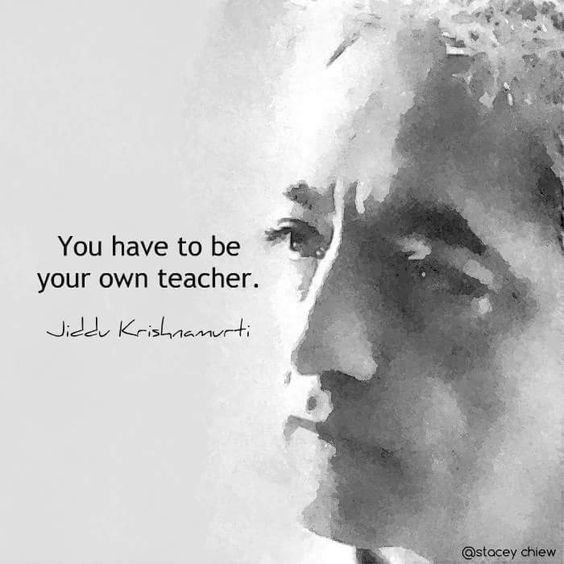
Palmer’s writings remind me of another philosopher that I grew up reading, Jiddu Krishnamurti.  He wrote about many things in India that transcend place and speak to all of us.  His treatise “On Education” evoked many parallel thoughts that Palmer’s writing did, and similarly David Katzeek’s words as well.

Everything is inside of us.

This is true for everyone and especially our future students.  The teacher’s job is to facilitate learning so that each person can realize the knowledge that already lives within them.  As teacher’s we must do this as well for ourselves.  We must reflect and become our own teacher as J. Krishnamurti suggests in the photo above.  Through reflection we can attain self-knowledge, and through self-knowledge we can learn to be better teachers as Palmer shared.  Without self-knowledge we cannot know how to connect with our students and our subject.  For me personally I really enjoy discussing reflections with others that I trust because it often leads to new insights.

Reflecting and sharing vulnerability with one another helped me to realize many similar feelings that I had, but not yet thought of.  I appreciated and will continue to ponder yesterday’s events throughout the next few weeks and beyond.

Parker Palmer

Mrs. Sanders, my senior year British Literature teacher, embodied what I believe to be a compassionate teacher both within the classroom and outside of it. She was a tiny ball of energy who began each class with “The Word De Jour”–something so simple, but we all looked forward to it every day. She connected with us on our love for Chick-fil-a (The most crave-worthy fast food place. Yes, tis better than In-N-Out hehe) and invited us to bring her a chicken biscuit and large lemonade whenever we did so please. She taught so energetically and so personally that I can still remember her explaining and drawing on the white board how the English language took shape with the Angles, Saxons, and Jutes. Somehow learning the Prologue to the Canterbury Tales in Middle English is still burned in my memory. I recite it from time to time just because. She encouraged me in the classroom with the smallest gestures such as simply telling me “Good job!” or “Study harder next time, LB”. The most impactful characteristic for me was the fact that she took interest in us outside of the classroom. She and her husband were present at mostly all of our basketball games, home and away games. By doing so, without having to say anything, she let us know that she cared about us as people. We weren’t just students in her classroom, we were young people with differing interests and an array of talents that she celebrated along side of us. And this isn’t something that ended when graduating from high school. She has encouraged me even to this day not only with her comments on my Facebook page about working toward a MAT, but also in her devotion to her students and love for teaching she displays in her everyday life. I hope to be half as influential to my students as she was to me and I’m sure countless others.

css.php